|
Trumbull-Nelson has Played
a Major Role in the Ongoing
Renovations at one of Dartmouth
College’s key Science Buildings.
by Eric Goldwarg
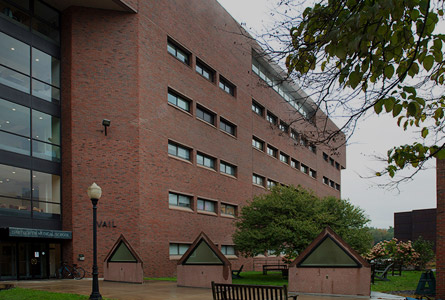
The Charles Gilman Life Sciences laboratory at
Dartmouth College was built in 1964 to provide a
home to the biology department. The building is
located near the intersection of College and North
Park Streets and connects to the Dana Biomedical
Library on the Dartmouth Medical School campus. It
was originally right next door to Mary Hitchcock
Memorial Hospital, before the hospital outgrew its
space and moved to its current location in Lebanon.
Since the Gilman building was built, the College’s
biology department has grown tremendously.
Today, Gilman contains lab space for 16 professors
(along with their technicians, graduate students,
post-doctoral fellows, and other employees),
computer labs, student common areas, and the
Murdough Greenhouses.
Ranging from cellular biologists and geneticists to
aquatic ecologists, the diverse labs in Gilman
provide space for a wide variety of research
interests.
Trumbull-Nelson has been part of ongoing renovations
in Gilman for over a decade, and, as such, has
played an important role in the biology department’s
expansion. As faculty members retire, move away, or
give up lab space, the vacated labs are thoroughly
renovated to the specs of incoming professors. The
process begins with Paul Tougas, Dartmouth’s Project
Manager, who works with the incoming professor to
determine their needs. He then consults with
engineers to design mechanical and electrical specs,
and he sends this information to Trumbull-Nelson for
an estimate.
According to Tougas, he continues to call on
Trumbull-Nelson because they have a lot of
experience in the building. “It’s a tricky place to
work,” he added. “There are a lot of people and
complicated systems at work.
Trumbull-Nelson has shown again and again that they
can get the job done well with very little
disruption to anyone or anything in the building.”
When Trumbull-Nelson receives the project from
Tougas, Cliff Saunders, a Trumbull-Nelson Project
Manager with over a decade of experience, enters the
picture. Cliff works up the estimate and sends it
back to Dartmouth for approval. Once they get the
green light, Trumbull-Nelson gets down to work.
Cliff explains that the projects “typically start
with an asbestos abatement performed by an
independent subcontractor, because many buildings
that age have asbestos in the concrete panels used
in the ceilings.” Trumbull-Nelson typically works
with ARC Mechanical and Richard Electric as their
primary subcontractors. Both companies know Gilman
inside and out from many years of work there.
Meanwhile, Trumbull-Nelson’s millwork shop is busy
building the custom cabinets, countertops, fume
hoods, and other pieces for the lab. The millwork
shop is comprised of five employees who specialize
in building custom projects, including cabinets,
casework, moldings, and trims.
This capability enables Trumbull-Nelson to be highly
efficient. After the individual cabinets are built
and finished in the shop, they are transported to
the lab and assembled into complete units along with
the fire- and chemical-resistant epoxy countertops
(which are made by Fisher Scientific).
Custom-designed pieces like these are very labor
intensive, but the end result is a beautiful,
functional space that perfectly matches the
occupant’s needs.
Much of Trumbull-Nelson’s role in the Gilman
projects is project management. Steve Locke and Tom
Beckett oversee Trumbull-Nelson’s operations at
Gilman. They manage the various subcontractors as
well as the millwork built by Trumbull-Nelson
itself. Finally, as the end draws near, final
details are ironed out with the incoming professor
to ensure that the space meets his or her needs
exactly.
The current Gilman project is a renovation of an
1,163-square-foot lab for Ryan Calsbeek, an
Assistant Professor just hired by Dartmouth. An
ecologist, Professor Calsbeek’s research focuses on
the ecological or evolutionary consequences of
natural and sexual selection, using lizards as the
primary study tool. While the lizards themselves
will be housed in the Animal Control Facilities in
the basement of Gilman, Professor Calsbeek’s
research led him to request specific features in his
lab.
Trumbull-Nelson’s millwork
shop builds the custom cabinets, countertops, fume
hoods, and other pieces
or the lab.
“We do a combination of field and bench work, so
part of our lab is pure molecular biology—lots of
open counters and shelves above the desks. However,
the center island workstation has benches on one
side with computer stations on the backside. This
creates a multi-use area where we can have lab
meetings, analyze data, and work away from the ‘wet’
portion of the lab,” Calsbeek explains. Having
researched lizards in both the Bahamas and
California, Professor Calsbeek and his students will
continue to study these lizard populations while
also branching out to other areas of interest.
Initially, the lab will be occupied by Professor
Calsbeek, his technician, and his dog (the “lab
Lab”), but the space will quickly fill with grad
students and post-docs.
At roughly 1,000 square feet per lab, none of the
Gilman projects are especially large, but the
various pieces of the puzzle mean that each lab
takes approximately four to five months to renovate.
With at least eight Gilman labs renovated by
Trumbull-Nelson in the last decade, there is almost
always a Gilman project in the planning stage or
under construction. Using a combination of
subcontractors and in-house experts,
Trumbull-Nelson’s vast project management experience
means that disruption to the building and the
biology department in general is kept to a minimum,
and incoming faculty can quickly move into their new
spaces and begin their careers at Dartmouth.
|