Table of Contents

Other Editions of CI Magazine


New Community Landmark:
Co-op Store Anchors a New Community

by Andi Diehn

The Co-op Community food Market on Lyme Road in Hanover may be a brand new store, but local visitors will likely find it very familiar. It’s the third of the Co-op food stores in the Upper Valley area—replacing the Co-op Service Station and Community Market Convenience Store—and Trumbull-Nelson has worked with designers and subcontractors to continue the Co-op tradition of creating a special place for people to gather in search of good food and good company. Need to grab a bite for lunch? Choose a meal from an array of prepared foods to eat at one of the tables, or take it back to the office. Missing a few salad ingredients for dinner? Stop by to peruse the produce, and don’t forget the dressing. The Community Market is an easy building to dash in and out of; it’s also a cozy place to sit and watch some of the world go around the roundabout.

Breaking Ground

“More and more people in the community showed a desire for more products than what the service station had to offer,” says Tony White, the merchandising and operations director of the Co-op. The little convenience store that was located on the corner of Lyme Road and Reservoir Road was good for the bare necessities, but frequent shoppers wanted more.

"We wanted to let the building interact with the neighborhood and the street."

“That area is becoming a new center for Hanover,” says Jim Wasser of UK Architects in Hanover, who worked on the building design. He’s referring to the Rivercrest Development and surrounding businesses that have grown up around the section of Lyme Road that planners are now calling Dresden Village. “We wanted to let the building interact with the neighborhood and the street.”

White, who sometimes refers to the new store as “my baby,” agrees. “That’s why the building is up on the sidewalk, so people can walk right up to the store.” Visitors who venture to the store on foot are greeted by an outdoor patio, a perfect place to eat a meal while gazing at the lovely view of the golf course.

“We finally got into the ground in early June 2008,” says Todd Thompson, project manager for Trumbull-Nelson. The Co-op hired Trumbull-Nelson in September 2007 to supervise the job, and together with UK Architects, planned and designed the building and parking lot to the Co-op’s specifications. By the end of February 2008 Trumbull-Nelson was seeking bids from subcontractors. After the Town of Hanover approved the plans, work on the site was finally begun.

“First it was a teardown job of the old structures,” Thompson explains. A service station had been on the site for a while, complete with leaking gas tanks, so all the soil had to be removed from around the tanks and a groundwater monitoring system installed to ensure no more damage ensued.

“The layout was an exploration for all of us,” says Wasser, who began the project independently from UK Architects, but became part of the UK team during the project. “We discovered we could get more square footage than what the Co-op originally asked for, as the layout of the land and parking lot left plenty of room for building.”

The resulting structure looks like it grew organically out of the dirt, belying the hours upon hours of planning.

Building Green

The Co-op’s General Manager is especially excited to see the new building go up. As a member of a Dresden Village community planning group that was formed by the Hanover Planning Board, Terry Appleby not only had a vested interest in the future of the Co-op, but also in the Village where the old convenience store was located. When asked why the Co-op chose Trumbull-Nelson, Appleby said, “We have used Trumbull-Nelson many times in the past for Co-op construction projects, and we have always had great results. Furthermore, Trumbull-Nelson’s experience with ‘green building’ projects, including our Lebanon Centerra store, was a huge factor, as was Todd’s LEED-certified (Leadership in Energy and Environmental Design) project manager status.”

Everywhere you turn at the Community Market you’ll find great effort towards sustainability. The structure is a wood-frame building with plenty of insulation. The walls are closed cells filled with spray-foam insulation and the roof is made of insulated panels consisting of a layer of plywood, a layer of foam, another layer of plywood, and then a coat of drywall. This creates a continuous layer of insulation with no seams to let out heat. How do we know all that insulation is doing its job? “We had an outside consultant do an air barrier test,” explains Thompson. “They over-pressurized the building and used theatrical fog to look for leaks. For a second test they used an infrared camera. This is an unusual step in the building process, and it’s evidence of a conscientious owner.”

The heat itself comes from a geothermal system, the outdoor portion of which is buried under the parking lot. “We dug eight wells 500 feet deep,” says Thompson. “We hit groundwater at around 300 feet and had to put it in a settling tank to let the drill cuttings settle out, then dispose of the water.” Despite this setback during the digging, the system is worth its weight in oil.

“It’s a heating device you’ve got to love,” says Thompson. “It’s the same device to blow heat as it is to cool, working well in a building where the heating and cooling needs match.” A glycol solution is warmed (or cooled depending on the season) in the wells by the earth’s ambient ground temperature, then transferred into the building and used by heat pumps to warm and cool the occupied spaces of the building. This geothermal system will eventually save the Co-op money.

"We wanted to make it as green a design as possible. Everyone on the team was part of that challenge."

Trumbull-Nelson installed several panels of translucent windows made by a local company, Kalwall in Manchester, which allow plenty of natural light into the central space while providing a much higher “R” level of insulation than ordinary windows. Six skylights provide more light deeper within the store, while special electric lights known as daylight harvesters measure the amount of sunlight and dim down accordingly.

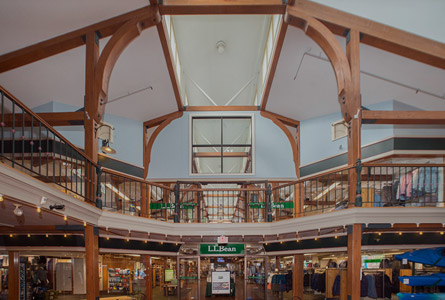
More news on the green front: the thick wooden beams that give the interior of the market a rustic New England feel are actually made of parallel strand lumber, which is a more sustainable kind of engineered wood product that uses young trees. A closer inspection of the timber element reveals what looks like lots and lots of shreds of trees glued together. These were made in the Trumbull-Nelson workshop on Lebanon Street and were assembled on site.

The exposed concrete floors, similar to those found in the Lebanon Co-op, are highly slip resistant for boots coming in off snow or mud, plus they negate the need to add more PVC product in the world. Outside, a pavement path winds around shallow basins that are meant to reduce the storm water impact on the town's storm water system. “These little pits capture a good portion of the water, let it sit and filter, and the water seeps back down to the aquifer,” explains Thompson.

White, who has been with the Co-op for 11 years, considered the environmental sustainability efforts to be in the forefront. “We wanted to make it as green a design as possible. Everyone on the team was part of that challenge,” he says. “The geothermal well system was problematic, but the engineers finally completed a design that will be really efficient.” The building’s energy costs will be about 50 percent less than those of a conventional heating system.

"The geothermal well system was problematic, but the engineers finally completed a design that will be really efficient."

Architect Wasser is no stranger to environmentally conscious businesses. Before moving to the Upper Valley three-and-a-half years ago, he worked in Portland, Oregon, on a number of sustainable projects, including a health food store. “UK Architects is strongly interested in sustainability,” he says. “There was a real synergy between UK and the Co-op.”

"In a lot of ways, we share cooperative principles, we overlap in business philosophies," says Thompson about the working relationship between Trumbull-Nelson and the Co-op. Thompson has been with Trumbull-Nelson since 2000, and was part of the team that built the café area at the Lebanon Co-op. These cooperative principles include using local products whenever possible and hiring local subcontractors, such as Defiance Electric and Notts Excavating.

While the energy-efficient components of the Co-op are impressive and worth boasting about, when asked what aspect of the building process he was proudest of, Mr. Thompson said, “I think T-N's work on the timber frame, which is a huge testament to our diverse set of skills. With our steel fabricator, DMS of Barre, Vermont, we detailed and fabricated all of the steel plate connections. Then, our carpenters pre-cut and pre-finished the entire wood frame in our yard. We pre-assembled the roof trusses in our yard and, with help from a timber frame erector, Great Northern Barns from Canaan, New Hampshire, assembled the entire frame in a couple of days.”

The Community Market opened the week after Thanksgiving, giving the Upper Valley community one more thing to be thankful for.