|
By KIM GIFFORD
Winter conjures images of cold winds, heavy snows,
and frozen ground. In northern climates, these
images are a harsh reality especially for those in
the construction trades who need to combat the
elements on a daily basis in order to accomplish
their jobs. Unfortunately, not only do winter
conditions present numerous challenges to
construction including frozen ground and lack of
vegetation, but these challenges also affect the
bottom line, leading construction to typically cost
more during winter than other times of the year.
This year, the problem is further compounded not
only by the rising costs of many construction
materials, but also higher fuel and diesel prices
necessary to keep workers warm and run heavy
equipment.
Material and Fuel Costs
As anyone in the construction field can attest, the
cost of building materials from lumber to asphalt to
gypsum products have risen over the last couple of
years, driven in part by foreign construction and
the destructive hurricanes of the last two seasons.
According to an Oct. 27 article by Les Christie for
CNN/Money, the cost of construction materials rose
by 11 percent from September 2004 to 2005, following
double digit increases for many materials from the
year before. Add to this higher fuel prices and most
of those in the industry are already facing
significant cost impacts going into winter.
Diesel fuel used for heavy equipment such as trucks,
excavators and backhoes has risen more than 50
percent. Doug Gurney of Gurney Brothers in
Springfield, VT said “With the high fuel costs,
we’re figuring between $10 to $15 an hour to run
some of the bigger excavators.”
The situation is especially challenging for those in
the concrete business. “We have the cost of the fuel
to run the loaders, the fuel to run the boiler to
heat the water, we’ve got the fuel for the mixer,
etc.” said Robert Carroll of Carroll Concrete in
Newport, NH.
Carroll also noted that while fuel prices in general
have come down from the highs witnessed earlier this
year, diesel fuel “has not dropped or changed as
drastically.”
“With the high fuel costs, we’re figuring between
$10 to $15 an hour to run some of the bigger
excavators.”
According to the same CNN/Money article, “high fuel
costs contributed to concrete prices…that rose more
than 12 percent through Sept. 2005.”
Jim Odorisio, project manager with Trumbull-Nelson
Construction Co. noted “With propane and oil costs
where they are today the cost of temporary heat [on
a job site] can result in cost impacts of $600 on up
per week.”
Ways to Cope
These rising costs have led some within the
construction trades to consider shutting down
projects during winter. A recent Portland Press
Herald article by Matt Wickenheiser reported on
several projects in Maine that will stop during the
winter including the $13 million construction of the
National Cold Water Aquaculture Center by Pizzagalli
Construction Company. By ceasing winter
construction, Pizzagalli anticipated a $250,000
savings.
“The most sound business practice would be to close
the doors from the middle of December until the end
of March,” said Carroll, who also noted, “we say we
have a short construction season, yet we’ve
lengthened it to the point where we close down
several of our plants in the winter, but not nearly
as many as we would like. It would be ideal to close
them all for three months in the winter, but we
can’t.”
At Trumbull-Nelson, Odorisio advises clients to try
and structure their projects to ensure that the
building is completely tight to the weather before
Thanksgiving or Dec. 1. “Depending on what the
permanent heating system is inside the building, you
may or may not be able to utilize that for
construction heat. You can save a significant amount
of the cost of temporary heat in this way,” he said.
This can be a valuable savings. As Carroll noted,
“the cost associated with trying to heat the site
before, during and after a concrete placement is
incredible.”
Even without the rising costs of fuel and materials,
winter presents its difficulties. Gurney estimated
that winter adds at least 25 percent or more to
construction costs.
Winter Challenges:
Productivity
One of the biggest issues has to do with
productivity. “As a general statement, productivity
might be half and sometimes you don’t do that well,”
said Bruce Temple, general manager at Morrill
Construction in North Haverill, NH. For Morrill
Construction, which handles a lot of road and site
work, a hard frost can make it extremely difficult
to perform their work. “We can deal with cold
weather, but once the frost starts to penetrate
roadways it is extremely difficult to do utility
work,” he said.
Frost in New England can drive down as far as five
feet in the ground, experts report. In order to dig,
it is sometimes necessary to use jackhammers or in
extreme cases even blast the frost.
“If you are digging in deep frost you don’t make
good production rates,” said Dan Nash,
vice-president of Bruno Associates in Woodstock, VT,
an engineering and surveying firm.
Cold temperatures and decreased daylight also affect
productivity. Not only are there less hours of
daylight for people to work, but also the cold means
it takes longer for equipment to warm up, and time
and effort must be spent in setting up temporary
heating or even lighting equipment.
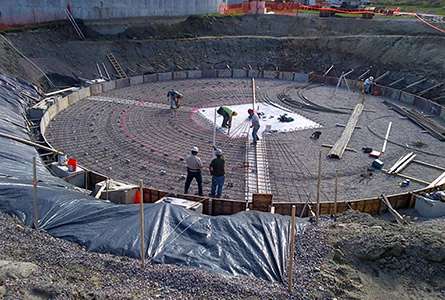
Heating Concrete
Those in the concrete business face some specific
difficulties in working outside during the winter.
“The first problem we face is getting the concrete
to the temperature we need it to be in order to
hydrate,” said Carroll. “In order to do that, we
have to heat the aggregates or heat the water, or
both. There is a huge fuel cost to producing enough
hot water to raise the temperature of the
aggregates. You have to have a facility where you
can get the materials from the ground inside and
give it time to thaw. You also have to remove snow
and debris.”
Snow
Removal
Snow removal becomes time consuming, robbing from
the time workers could be devoting to their regular
jobs. Materials must also be stored out of the
elements for their protection. Frequently, this can
be accomplished with a tarp, but this collects snow,
adding to the time it takes workers to access
materials.
“We can deal with cold weather, but once the frost
starts to penetrate roadways it is extremely
difficult to do utility work.”
“Another major issue is safety,” said Odorisio. “As
the ground freezes, there is the possibility that
workers might trip and slip. It is important to keep
the job site as neat and clear as possible.”
Carroll noted that dealing with snow is “a double
edged sword. On the one hand, it insulates the
ground and prevents frost from getting in deep. At
the same time, you have one more factor – you have
to deal with getting around the snow. Once you
remove the snow, the frost is able to get back in.”
Winter also creates some difficulties in managing
the construction site. Nash explained that when
doing any earthwork on site, the frozen chunks of
ground contain water that can cause real problems in
the spring. “You aren’t supposed to place them in a
fill embankment. What happens is in the spring when
they thaw you are basically left with a lump of mud
that can cause a sinkhole,” he noted.
Winter construction also means a lack of vegetative
cover to prevent erosion. Workers use a lot of
crushed stone around the site to prevent mud from
falling and to provide a hard surface for vehicles
to go over without creating mud. This crushed stone
creates an additional expense.
The Solution
Given the challenges of winter construction, many
companies try to figure the costs up front into
their initial contracts. “When it’s a lump sum bid
project and you know the time frame in advance, of
course, all these factors will be figured into your
bid,” said Odorisio. “If it’s a negotiated project,
that’s when we will review the current schedule with
the owner, and advise him of the difficulties and
costs associated with winter construction. We try to
demonstrate to the client the advantages of
expediting certain operations in an effert to get
them completed before winter weather hits. There may
be a cost impact from accelerating the schedule, but
if we’re successful we will be able to minimize the
cost impact and schedule impact of the winter
months.”
Indeed, many within the construction industry try to
schedule products to conclude by the middle of
December.
“I say everyone would be a lot better off if they
closed the doors December 15 and came back April 1,”
Carroll emphasized. Yet, most realize that a total
shutdown is impossible. Not only do projects need to
be completed, but also workers need to make a
living. “People need a place to come where they can
continue their health care. I think part of [the
reason for staying open] is just the need of people
to continue to work.”
|