|
By Laura Jean Whitcomb
The phone rings and Mitch Ross answers: “Millwork.”
The following conversation is a series of
measurements combined with types of wood — almost a
foreign language to anyone not in the construction
business. But it’s extremely helpful to the caller
and to Ross, the Millwork Shop manager at
Trumbull-Nelson, and his team of woodworkers.
“Communication between the shop and the job is very
important,” he explains. “That’s why the phone rings
all the time. The flow of information is vital with
every job, no matter the size.”
Trumbull-Nelson maintains a fully equipped and
staffed architectural Millwork Shop, capable of
fabricating finished millwork products to the
highest quality standard and the most stringent
specifications. In fact, you’ve probably seen some
of the Millwork Shop’s work on your travels around
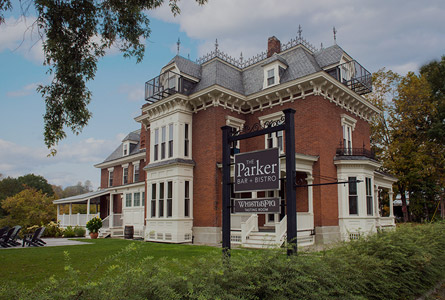
the Upper Valley: Hanover restaurant The Wrap’s
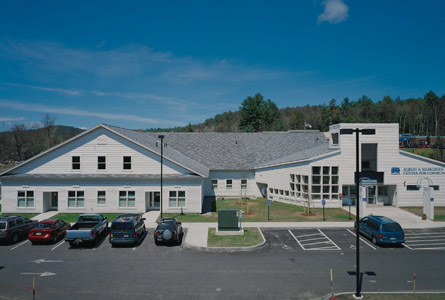
curved bench, the cabinets at Richard W. Black
Community & Senior Center in Hanover, the display
counters and cupboards at Jake’s Market in New
London, and the half-round receptionist desk at the
Quechee Gorge Visitor Center.
“Communication between the shop and the job is very
important. That’s why the phone rings all the time.
The flow of information is vital with every job, no
matter the size.”
Millwork is a general term that encompasses
different types of woodworking, such as moldings,
trim work, trim details (for example, ornate
brackets), and case work (cabinets and shelves). “We
can build anything — and we have,” says Ross. He’s
been in the business for 25 years (12 at
Trumbull-Nelson) and took the position as manager a
year ago. The Millwork Shop team — comprised of two
cabinetmakers, an apprentice cabinetmaker and an
apprentice — have been recently working on six jobs,
including the Corey Ford Rugby Clubhouse at
Dartmouth College and the Howe Library in Hanover.
A typical millwork project consists of both on-site
project work and off-site shop work. “We get out
there and see the location that the millwork is
going into,” says Ross. “We look for outlets, pipes,
heating — any existing structure that has to be
taken into consideration before the millwork is
installed.” He notes that on one project this summer
— a private library for existing residence in
Cornish, N.H. — that the walls were out of plumb and
the floors were sloped. “Those things need to be
taken into consideration for the cabinets to come
out plumb and square.”
Back in the shop, Ross goes through the set of plans
and the scope of work to make a list of the
materials to order. He drafts up some drawings for
the architect for approval or, if there is no
architect on the project, some sketches of how the
piece is going to come together for the woodworker.
Creation takes place in the Millwork Shop, a
building located directly behind the Trumbull-Nelson
main offices on Lebanon Street in Hanover. There are
five benches (one for each woodworker) loaded with
stationary tools, power tools and hand tools. The
shop boasts an array of tools: 12-inch table saw,
24-inch sander, 36-inch planer, 12-inch joiner,
10-inch table saw, a new portable molding machine —
“We can duplicate any molding that comes in,” says
Ross — an edge bander, shaper, inline boring
machine, band saws, drills and lathes. There are
also calculators all over the place, since
architectural millwork requires knowledge of
trigonometry, geometry and plenty of basic math.
"Nothing is beyond our skill, we’ve always been able
to figure it out."
Ross points out a new state-of-the-art spray booth,
complete with AirFlow Tech doors at one end and an
exhaust fan behind a wall of filters at the other
end. “This room has a large capacity — we can easily
get a whole kitchen in there. It’s even big enough
to drive a vehicle into.” The spray machine can
provide lacquer finishes in any color.
Sometimes T-N’s woodworkers install the work on
site; other times it is sent to the job for
installation by the project team. The Millwork Shop
has seen quite a bit of intricate work recently.
Take, for example, the Church of Christ at Dartmouth
College. A renovation for a new 10-ton organ
required new supports and footings that had to
extend to the basement. T-N’s Millwork Shop was
responsible for creating a new screen behind the
organist, duplicating of some of the existing pulpit
and lectern as well as crafting new pews and privacy
screens. An 18-drawer wooden cabinet in the Millwork
Shop holds some of the special knives created to
reproduce the 1930s moldings.
“Nothing is beyond our skill,” Ross says. “We’ve
always been able to figure it out.”
Ross hopes that clients are aware of all the work
that takes place behind a finished architectural
millwork piece — but doesn’t want them to worry
about it. “They just need to know that we are going
to give them the best product we can possibly give
them — and try to do it in the shortest amount of
time,” he says. “We want the client to say at the
end of a project ‘What a great job. We’re very
happy.’“
And Ross and his team go out of their way to ensure
satisfaction with every project. Ross tells the
story of a customer from Maine who stopped in with
measurements for bookshelves he wanted built for his
new house.
“We relied on his measurements and sent detailed
sketches back and forth. The shelves fit perfectly.
He was very happy, even writing a letter to the
office about his experience,” he recalls. “Then the
shelf pins never came in. He had to wait three weeks
to put up his new bookshelves. I was worried that
this would ruin his feelings about the job, but when
I called him to check he said, ‘I’m not even going
to remember that part. You did a great job.’ The
road may sometimes be rocky, but we want our
customers to be as happy as possible with the end
result.” |