|
Worth the Wait
By Jack Degange
Corey Ford, who died more than 35 years ago, would
be pleased. For several hundred Dartmouth rugby
alumni and players who have survived about 20 years
of off-field trying, their vision of the Corey Ford
Rugby Clubhouse is a reality.
Designed by architect Randall Mudge and built over
the past 15 months by Trumbull-Nelson, the Corey
Ford Clubhouse gives Dartmouth rugby players a place
they finally can call “home,” a facility that is
unmatched in the spectrum of collegiate athletics.
Located less than a mile north of the Dartmouth
College campus, the 6,000-square foot clubhouse
nestles into a slope of the former Garipay Farm
property (now owned by Dartmouth). The clubhouse is
destined to be one of Dartmouth’s distinctive
buildings. It may be the only rugby clubhouse in the
world designed to provide symmetrical, unified
facilities that serve men and women.
The Corey Ford Clubhouse gives Dartmouth rugby
players a place they finally can call “home,” a
facility that is unmatched in the spectrum of
collegiate athletics.
The clubhouse is a story of ultimate collaboration
involving the College and hundreds of Dartmouth
rugby players and parents, including over a dozen
leadership donors. It’s also the culmination of
years of scrumming, beginning in the mid-1980s. The
circuitous route that brought the clubhouse back to
its originally intended site included legal action
by concerned neighbors in Hanover, the machinations
of municipal planning review when the clubhouse
seemed destined to be part of a
residential-recreation complex proposed by the
College at Sachem Field, south of Hanover in
Lebanon, N.H., and a Hanover-Dartmouth transaction
involving the Garipay property that didn’t happen.
Rugby is an independent, self-supporting club sport
at Dartmouth, not one of the College’s 34
intercollegiate teams for men and women. At
Dartmouth, football (the American version) evolved
from the English game of rugby about 130 years ago.
As football grew, rugby disappeared until the DRFC
was established in 1951. The Dartmouth Women’s Rugby
Club (DWRC) was formed in the late 1970s.
That was also the year that Corey Ford, a Columbia
University graduate and noted author, moved to
Hanover. It’s uncertain whether Ford adopted the
DRFC or vice versa but the story of the rugby
clubhouse begins with Mr. Ford.
His home on North Balch Street, near the campus and
the playing fields, became the unofficial Dartmouth
rugby clubhouse. Ford once wrote, “My own playing
experience is limited to a few scrums in the New
York subway at rush hour. I am hailed as ‘Coach’ for
want of a better title. In the locker room before a
match I sit in owlish silence, sucking on my pipe
and occasionally nodding my head up and down sagely.
I’ve heard the team has a secret maneuver called the
Corey Ford play. I haven’t the foggiest idea what it
is, and nobody will tell me.”
Ford also saw rugby, with its fundamentally amateur
atmosphere, as the answer to creeping
professionalism in college athletics. When he died
in 1969, his estate included a bequest to Dartmouth
designated for the support of rugby. That included
the intention for a permanent rugby clubhouse.
Over the years, the sport has flourished to include
the Dartmouth women’s rugby team, now over 25 years
old. The two programs, men and women, rank with the
best teams in the nation. Each has won Ivy League
and New England championships and competed in
national tournaments. Each spring since 1951, with
one exception, the Dartmouth men have made annual
tours against national and international opponents.
The women’s teams have made similar tours for about
20 years.
Concurrently, the Dartmouth rugby endowment, built
from Ford’s original gift, has grown through
subsequent fund raising. After being shuttled from
site to site, the Corey Ford Clubhouse seemed a
reasonable expectation for an organization that did
all it was asked to do. About two years ago,
Dartmouth President James Wright said, in essence,
“Enough. It’s time for this to happen.”
Benefiting from President Wright’s support, the
clubhouse returned to the originally planned site.
Ground was broken for the building in May 2004. Over
the past year, though the construction schedule was
plagued in its early stages by uncooperative
weather, Trumbull-Nelson’s team has brought the
project to fruition.
The building sits in a landscaped bank that creates
a natural amphitheater overlooking George Brophy ’56
Field to the south, an emerald expanse that
incorporates a state-of-the art irrigation and
drainage system and is the competition site. The
companion George (Skip) Battle ’66 Field, on the
north side of the clubhouse near Reservoir Road, is
a pitch where B- and C-side matches will be played
and teams will practice.
The overall site is positioned in a hollow, a
setting that capitalizes on the beauty of nearby
Balch hill to the east and woods on two sides of
Brophy Field.
The main level of the clubhouse commemorates the
sport’s tradition at Dartmouth. Paneled trophy rooms
and a kitchen-serving area flank the Deevy Room,
given in memory of Bill Deevy ’47 by his three
Dartmouth sons. This large, central area, crowned by
a vaulted ceiling and elevated panels where shirts
from historic games will be mounted, will be the
setting for post-game receptions and other events.
There’s a dramatic stone fireplace and balcony at
one end of the Deevy Room. At the opposite end, a
glass wall looks onto the John Kilmartin ’75 Deck
that provides spectators with an elevated vantage
point to watch matches on Brophy Field.
Changing rooms for Dartmouth teams and opponents
surround a trainer’s room on the Brophy Field level.
A challenge gift by Kelly Fowler Hunter ’83, one of
the earliest members of the women’s team, was
instrumental among naming gifts for this area of the
clubhouse.
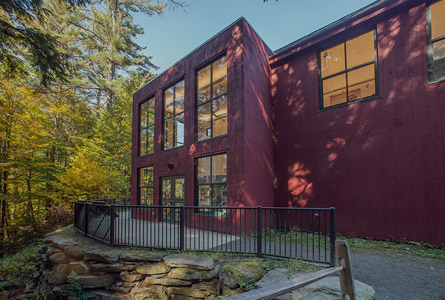
And a remarkable, distinctive building it is. The
exterior, with its eye-catching western red cedar
shingles is accented by the forest green paint on
shutters and the forged metal railing that curves
around the Kilmartin Deck.
Integrated into the paneling immediately inside the
main entrance that has a granite floor, a large
granite tablet is inscribed with the names of 400
donors. Many of them were among more than 500 guests
who descended on Hanover in late September for a
dedication weekend that included alumni games (for
women and men who are willing). The Dartmouth
women’s A side played Harvard in the first match on
Brophy Field, followed by the men’s A side against
Army.
As impressive as the tablet recognizing the
generosity of the Dartmouth rugby family is another
tribute that honors the genesis of this building.
Centered in the exterior wall between the doors that
provide access from the changing rooms to Brophy
Field is a curved granite tablet. In large, carved
letters are four words: Corey Ford Rugby Clubhouse.
Ford once wrote, “Rugby is strictly a game of the
players, by the players, and for the players.” At
Dartmouth, the sport isn’t quite so informal as it
once was. Thirty-six years since his death, and
after more than two decades of struggle as taxing as
any scrum, Dartmouth rugby’s men and women, students
playing a sport described by Ford as an “athletic
stepchild,” finally have a home of their own. |